Affiliate disclosure: PicksLab earns commissions on qualifying Amazon purchases via the pickslab-20 tag, at no extra cost to you.
You close the office door for a few calls, or cook dinner while the windows stay shut for the weather. Is the room getting enough fresh air? Did cooking leave particles hanging around? Those are different questions, and a purifier’s little green light may not answer both.
The Qingping Air Monitor Lite shows carbon dioxide, fine particles, temperature and humidity on one small screen. Its useful trick is putting CO2 and particle trends together: rising CO2 can prompt a ventilation check, while a particle spike can prompt a look at the source, exhaust or filtration. The monitor doesn’t clean the air, but it can help you decide what to investigate.
Quick answer: The Lite makes sense for ongoing room trends when you want CO2 and particles together and can leave it near USB power. Its short battery life makes it less attractive as an all-day portable monitor. It doesn’t measure VOCs, radon or carbon monoxide, and it cannot replace a smoke or CO alarm.
| Product | Price checked October 28, 2026 | The reason to consider it |
|---|---|---|
| Qingping Air Monitor Lite | $76.00 | CO2 and PM2.5/PM10 readings on one display; Apple Home integration with conditions |
This was the ordinary new US Amazon offer visible October 28, before tax. The exact Lite listing showed In Stock and an enabled Add to Cart control, shipping by Amazon and sale by Qingping Store. Availability and price can change. Qingping’s own US store displayed the same model but marked it sold out when checked; the linked purchase path is the verified Amazon offer.
1. Qingping Air Monitor Lite
Buy the Qingping Air Monitor Lite on Amazon
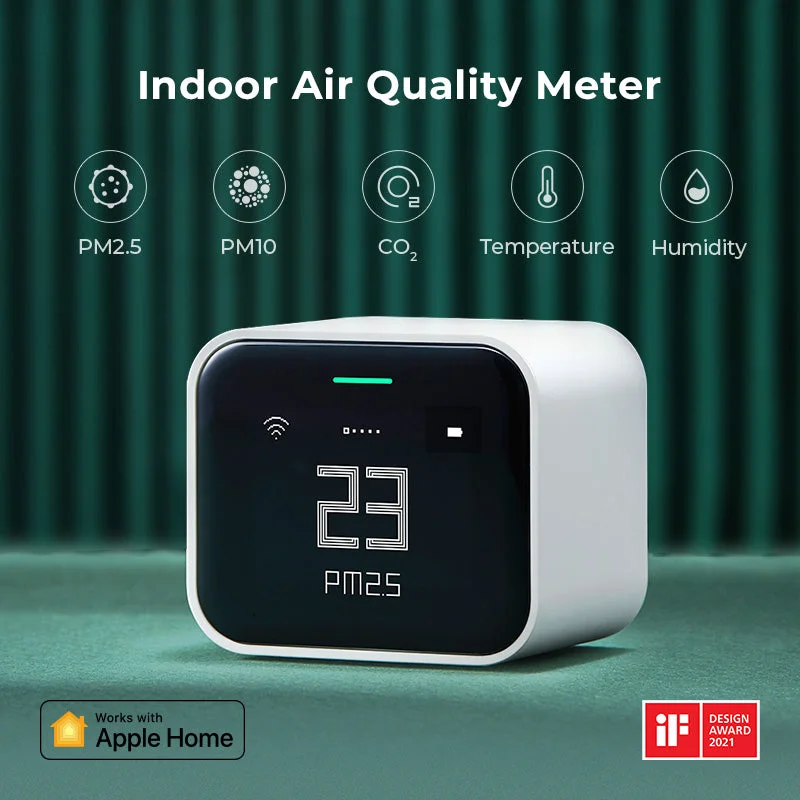
Product image: Qingping.
Price checked: $76.00, October 28, 2026.
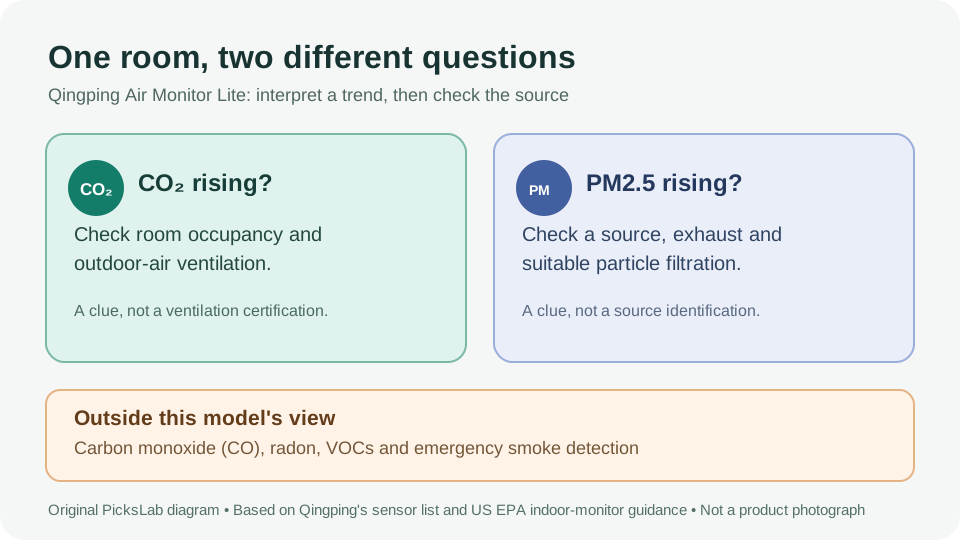
Original PicksLab decision diagram based on Qingping’s sensor list and the EPA’s indoor monitor guidance. It illustrates decisions, not the device’s appearance or a test result.
Key specs: CO2 measurement range: 400–9,999 ppm; PM2.5 and PM10 ranges: 0–500 µg/m³ each; Wi-Fi: 2.4 GHz; Power: USB-C input and a 2,000 mAh rechargeable battery.
These are Qingping’s published specifications.
Choose it for the two-sensor decision. The Lite measures CO2, PM2.5 and PM10 as well as room temperature and relative humidity. That gives a household a way to notice a rise in CO2 while people occupy a room and a separate rise in particles during cooking or other activity. Qingping says its OLED screen cycles readings with a top touch bar. The device is compact, but its published battery life is only up to seven hours; Qingping recommends leaving it plugged in. A USB-C cable is supplied, but check that an appropriate 5V/1A power source is available where you plan to place it.
Skip it if you need VOC, radon, carbon monoxide or emergency smoke detection. None is on this model’s sensor list. A CO2 reading is not a CO alarm. The EPA distinguishes consumer air monitors from certified emergency alarms. Keep proper smoke and CO alarms regardless of what this display reports.
The official Qingping app and setup notes matter for a US buyer: Mi Home is not supported in America and Europe. Apple Home remote access and automation require a HomePod or Apple TV home hub; 2.4 GHz Wi-Fi is specified. Qingping recommends Qingping+ for firmware updates before first use. These app conditions do not prevent reading the local display.
What a rising reading can and cannot tell you
| Reading you notice | Sensible first check | What the number does not establish |
|---|---|---|
| CO2 trends upward while a room is occupied | Check the outdoor-air ventilation path and whether opening a window is appropriate for the conditions outside. | It is not a complete ventilation test or a health diagnosis. |
| PM2.5 rises during cooking or an indoor activity | Check the source and exhaust first; then consider filtration suited to particles. | It does not identify every pollutant or prove a particular source caused the rise. |
| Both stay low | Keep ordinary source control and ventilation habits. | The room is not certified safe: this model does not measure CO, radon or VOCs. |
This is a decision aid, not a health threshold chart. The EPA says low-cost monitors only detect their designed pollutants and warns against deriving health risk from one reading. Its examples include improving ventilation when CO2 rises in an occupied classroom and increasing cooking exhaust when particles rise. Opening a window can be the wrong response when outdoor smoke or pollution is high; consider the outdoor conditions first. A purifier can help with particles, but the Lite’s CO2 reading answers a different question than particle filtration.
For a usable trend, put the unit where people spend time and air can reach its rear inlet. The EPA suggests a typical breathing-zone height of roughly 3–6 feet, away from direct drafts, cooking sources and an air cleaner’s outlet when you want a representative room reading. Placement changes what the sensor sees.
For example, leave it in the same office location through an ordinary workday and note when the room is occupied and the door is closed. Compare the trend after a sensible ventilation change, accounting for outdoor conditions. In the kitchen, watch whether particles rise during cooking and fall after using an outdoor-venting hood. Don’t put the sensor directly over the pan, and don’t change its location between every reading. Consistent placement makes the comparison more useful than a collection of unrelated snapshots.
App and power conditions before buying
Qingping’s US product page lists Apple Home, Mi Home and Qingping+ support, but its current regional note says Mi Home is not supported in America and Europe. For remote Apple Home access and automation, Qingping says you need a HomePod or Apple TV home hub. It also says temperature/humidity automation needs iOS 15.1 or later and a current hub version. The official Qingping product and setup notes recommend the Qingping+ app for first-use firmware updates and say it can export the latest 30 days of data. The device uses 2.4 GHz Wi-Fi. Check that your network and intended Apple Home setup meet these conditions before buying for remote automation; the local display is the simpler use case.
The rechargeable battery is a short unplugged option, not a plan for days of room monitoring. Qingping says the device may turn off after ten minutes unplugged under its default setting to save power; that setting can be changed in the app. Plan a stable USB power location and keep the air inlet unblocked.
How it compares with other monitors and a purifier
| Device approach | What it can answer | Key limitation in this comparison |
|---|---|---|
| Qingping Air Monitor Lite | CO2 and PM2.5/PM10 trends on a local display | No VOC sensor; short battery life |
| Awair Element | Maker lists CO2, PM2.5 and TVOC | Different ecosystem; we did not verify a current purchasable offer here |
| Temtop M10+ | Maker lists CO2, PM2.5 and VOC | Different app and sensor mix; current purchase path not verified here |
| Particle air purifier | Can remove some particles if selected for room size and maintained | Does not measure or remove occupants’ CO2 |
These alternatives address different sensing needs. If particles alone concern you, a PM2.5-only monitor answers a narrower question but misses the room’s CO2 trend. If VOC trends matter, Awair and Temtop include that capability. Extra sensor types don’t establish better accuracy; the table describes documented functions, not a laboratory ranking.
The Qingping Lite does not replace a particle air purifier or a ventilation plan: it displays measurements rather than removing pollutants. The EPA’s guide to air cleaners says to match a cleaner’s particle CADR to the room and account for filter replacement; gas removal is a separate capability. Purifier size, filter costs and noise should drive that purchase, not the monitor’s brand. For remote automation, distinguish the smart-home hub and network requirements from the monitor’s basic local display; not every hub is an Apple Home hub.
FAQ
Does the Qingping Air Monitor Lite detect carbon monoxide?
No. It measures carbon dioxide (CO2), which is a different gas. Use certified carbon-monoxide alarms for that emergency warning, as the EPA explains.
Will an air purifier lower its CO2 reading?
A particle filter addresses particles, not the CO2 added by occupants. Investigate outdoor-air ventilation if CO2 is rising, while considering outdoor smoke or pollution before opening a window. The two readings should lead to different checks.
Does it need Wi-Fi to show a reading?
The device has a local OLED display. Wi-Fi and compatible apps are for remote data and automation; Qingping specifies 2.4 GHz Wi-Fi for those features. A USB power source is more important for continuous display because the stated battery life is up to seven hours.
Is its reading a medical or regulatory safety result?
No. The EPA cautions that low-cost indoor monitors have limited performance evidence, do not show every pollutant and cannot alone establish a health risk. Use trends to decide what to investigate, not as a diagnosis.
Bottom line
The Qingping Air Monitor Lite is useful when you want to understand what changes in a room through the day, especially whether to investigate ventilation or particles. Plan to leave it plugged in, use the app that supports your region, and act on the pattern rather than treating one number as a health verdict. Buying the monitor gives you information; improving the air still takes a separate action.
This article contains affiliate links. PicksLab may earn a small commission at no extra cost to you. Our recommendations are based on the review method described in this article.