Affiliate disclosure: PicksLab earns commissions on qualifying Amazon purchases at no extra cost to you.
The controller dies, the kids’ toy stops working, and somehow the drawer contains every battery except a charged pair. Rechargeable AAs and AAAs can make that routine less wasteful, but the charger needs to match both your batteries and how you use them. Four slots are enough for occasional swaps. A houseful of battery-powered devices may need eight, while an old mixed collection needs a way to find the weak cells.
Those are three different purchases. A display that says “full” doesn’t necessarily measure how much useful capacity a battery has left, and a slot that physically fits an AA doesn’t prove the charger supports its chemistry.
TL;DR - Our top pick: The Panasonic BQ-CC55 is the sensible starting point for a household using eneloop AA/AAA cells: independent slots, clear status lights and faster charging than the basic CC17 for a small price difference. Choose Tenergy for eight-cell batches or XTAR when you actually want a capacity-testing function.
Prices and What You Still Need
Prices checked October 21, 2026, in ascending order. These are ordinary new US offers with active purchase controls, not Prime-only discounts. Prices exclude tax and batteries. The two Panasonic offers, Tenergy and XTAR showed free non-Prime shipping only with a qualifying order over $35; the D4 showed free delivery. Don’t add unnecessary products just to meet a shipping threshold.
| Product | Price checked | Main reason to buy | Power and purchase caveat |
|---|---|---|---|
| Panasonic BQ-CC17SBA, white | $15.64 | Basic four-cell eneloop charging | Wall plug; checked delivery was October 29-November 2 |
| Panasonic BQ-CC55SBA, white | $18.48 | Faster four-cell eneloop charging | Wall plug; batteries sold separately |
| Tenergy TN480U | $23.99 | Eight independent NiMH slots | Needs a suitable 5V/2A USB supply |
| XTAR VC4SL | $29.47 | Charging plus capacity testing | USB-C; verify adapter inclusion before ordering |
| Nitecore D4 | $36.85 | AA/AAA plus supported cylindrical lithium cells | AC-powered desktop unit; not the car-adapter bundle |
The USB models’ prices aren’t a promise of a complete mains-powered kit. Tenergy’s official package list specifies the charger; check your cable and power supply. XTAR’s selected offer did not clearly establish an included wall adapter, so budget for one if you don’t have a suitable supply. None needs a phone app or subscription.
Charging Features That Actually Differ
| Product | AA/AAA support | Slots and status | Capacity testing? |
|---|---|---|---|
| Panasonic CC17 | Panasonic eneloop/eneloop Pro NiMH | 1-4 independently monitored cells; green LED per slot | No measured discharge-capacity mode documented |
| Panasonic CC55 | Panasonic eneloop/eneloop Pro NiMH | 1-4 independently monitored cells; three-color LED per slot | Status estimate, not an analyzer |
| Tenergy TN480U | NiMH AA/AAA | 1-8 independent slots; LCD charging status | No discharge-capacity test documented |
| XTAR VC4SL | 1.2V NiMH; also specified 3.6/3.7V lithium-ion cells | Four bays; LCD and selectable operating modes | Yes, real-capacity testing function |
| Nitecore D4 | NiMH/NiCd AA/AAA; other listed cylindrical sizes/chemistries | Four independent slots; voltage/current/progress display | No discharge-capacity test documented |
Read the Battery Label Before Buying a Charger
“AA” describes a size, not a charging method. For this guide, the ordinary household route is 1.2V NiMH rechargeable AA/AAA cells. The Panasonic recommendations are specifically grounded in Panasonic’s eneloop/eneloop Pro compatibility documentation. Don’t assume an unrelated battery is approved merely because it fits.
Disposable alkaline cells must not go into these chargers. Nor should you treat a rechargeable 1.5V lithium AA as the same thing as NiMH or a 3.6/3.7V lithium-ion 14500. XTAR explicitly says its Li-ion/NiMH charger category does not charge 1.5V AA/AAA lithium-ion batteries. Those require their specified charging system. Check the device’s battery requirements too; matching the charger doesn’t establish that a cell is appropriate for your device.
This is also why the Nitecore F2 isn’t on this list. Its official manual describes lithium-ion/IMR charging, not household NiMH AA/AAA charging. A flexible battery holder isn’t universal compatibility.
1. Panasonic BQ-CC17SBA
Buy Panasonic BQ-CC17 on Amazon ->
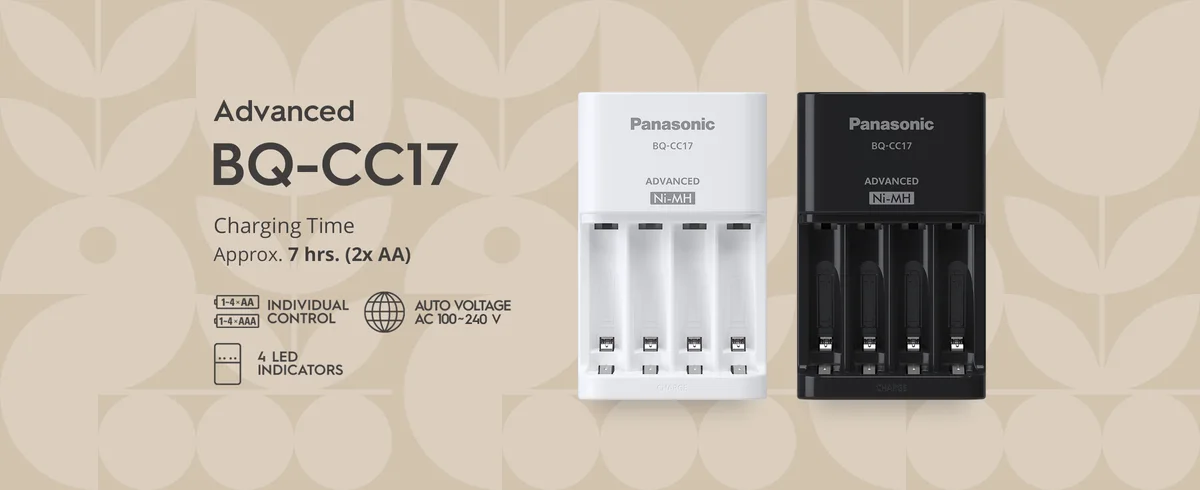
Image: Panasonic. The linked offer is the white charger without batteries.
Key specs: Cells: 1-4 eneloop/eneloop Pro AA or AAA; Input: 100-240V AC; Indicators: four green LEDs; Standard-AA reference time: approximately seven hours.
The $15.64 CC17 is a basic plug-in charger with one useful capability cheap pair-based chargers may lack: each slot works independently. You can charge one depleted cell or a mixture of supported AA and AAA cells instead of finding a partner for each battery. Its green lights turn off when charging finishes.
Panasonic’s CC17 reference times are about seven hours for standard eneloop AAs and nine for higher-capacity Pro AAs, subject to cell condition and temperature. That’s fine when charged spares are already in the drawer. Skip CC17 if a dead controller means waiting to play: CC55 was only $2.84 more, making slow charging a questionable saving for that routine.
2. Panasonic BQ-CC55SBA
Buy Panasonic BQ-CC55 on Amazon ->
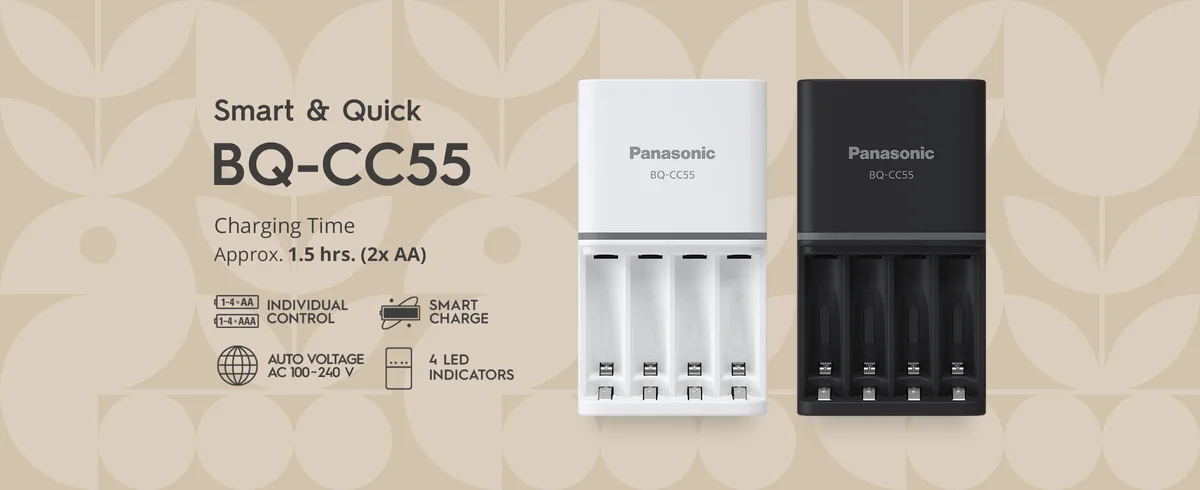
Image: Panasonic. White and black versions are illustrated; the linked offer is white.
Key specs: Cells: 1-4 eneloop/eneloop Pro AA or AAA; Input: 100-240V AC; Indicators: individual three-color LEDs; Standard-AA reference time: 1.5 hours for 1-2 cells or three hours for 3-4.
At $18.48, CC55 is the practical default for an eneloop household. You get a quicker turnaround without adding a screen full of settings. Panasonic’s charging table ties those times to standard 1,900-2,000mAh AAs; higher-capacity Pro cells take longer. They’re reference times, not a promise for every partly charged battery.
The red, yellow and green lights give a rough remaining-charge indication during charging. They don’t tell you that an aging cell can still deliver its original capacity. Skip CC55 if your problem is identifying weak batteries rather than replenishing them; that calls for the VC4SL’s testing function. For normal swaps, the simpler interface is part of the appeal.
3. Tenergy TN480U
Buy Tenergy TN480U on Amazon ->
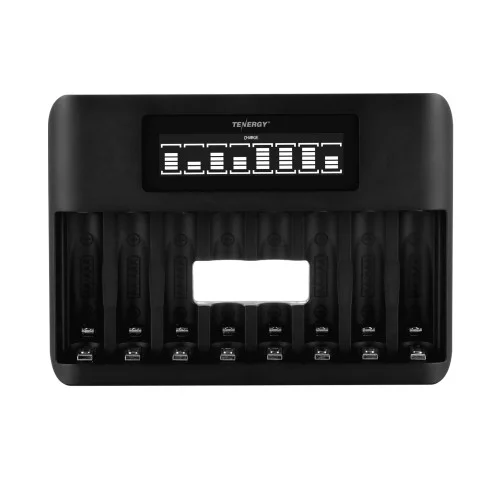
Image: Tenergy.
Key specs: Cells: 1-8 AA/AAA NiMH; Input: 5V/2A through USB-C or Micro-USB; AA charging current: 500mA per slot; AAA charging current: 250mA per slot.
The $23.99 TN480U solves the queue problem: charge eight supported cells together rather than reloading a four-slot charger halfway through the household batch. Its official specification confirms individual slots, so you don’t need eight batteries or matched pairs to start. The LCD shows charging status.
Its advantage is capacity across the slots, not proven fastest charging per battery. You’ll also need a suitable USB supply; an old low-output port may not match the specified input. Skip TN480U for lithium-ion cells or battery-health analysis. Buying eight bays doesn’t add either function, and a two-cell household may find CC55 easier to live with.
4. XTAR VC4SL
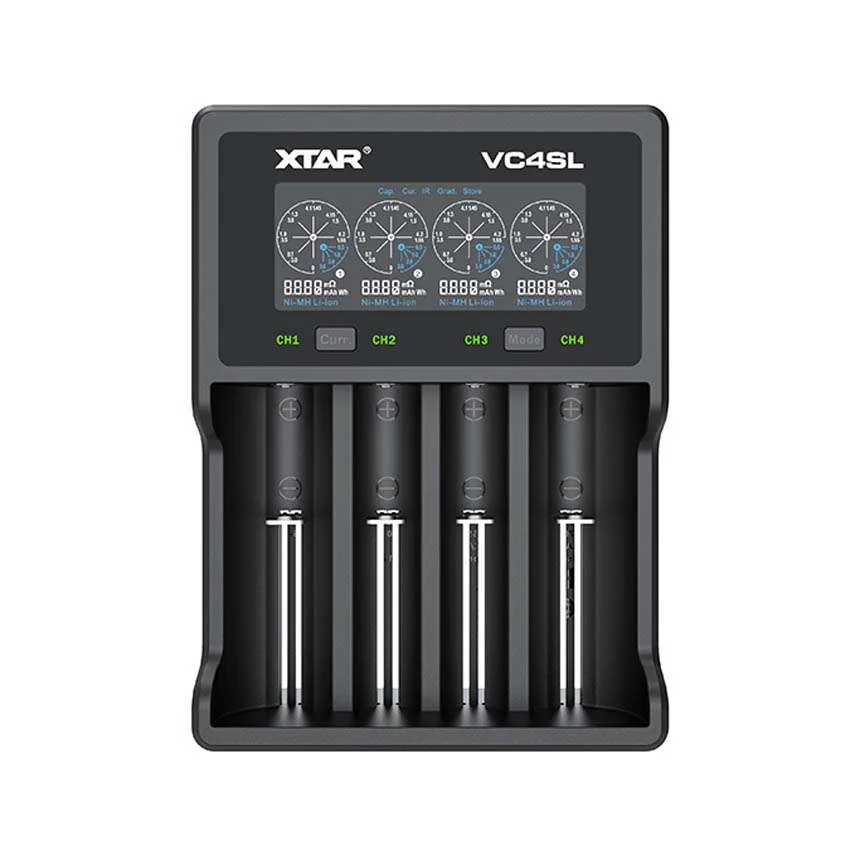
Image: XTAR.
Key specs: Bays: four; Supported chemistry: 1.2V NiMH and specified 3.6/3.7V Li-ion; Input connector: USB-C; Analysis: real-capacity test and storage functions.
The $29.47 VC4SL is for the drawer of rechargeable batteries that no longer seem equally good. XTAR documents a real-capacity testing function, which is the meaningful upgrade over a charging-status light. Testing helps compare how much charge cells can deliver under the charger’s test conditions; it isn’t a guarantee of runtime in every device.
It also accepts specified cylindrical lithium-ion cells, but not every battery with “lithium” on its wrapper. Read the VC4SL operating guide and follow the correct mode. XTAR’s advertised maximum 3A single-slot figure should not be read as an AA charging recommendation. Adapter inclusion in this Amazon offer wasn’t clear; confirm it and the required supply before buying. Skip VC4SL if you simply want charged eneloops with no mode selection; CC55 is the more straightforward purchase.
5. Nitecore D4
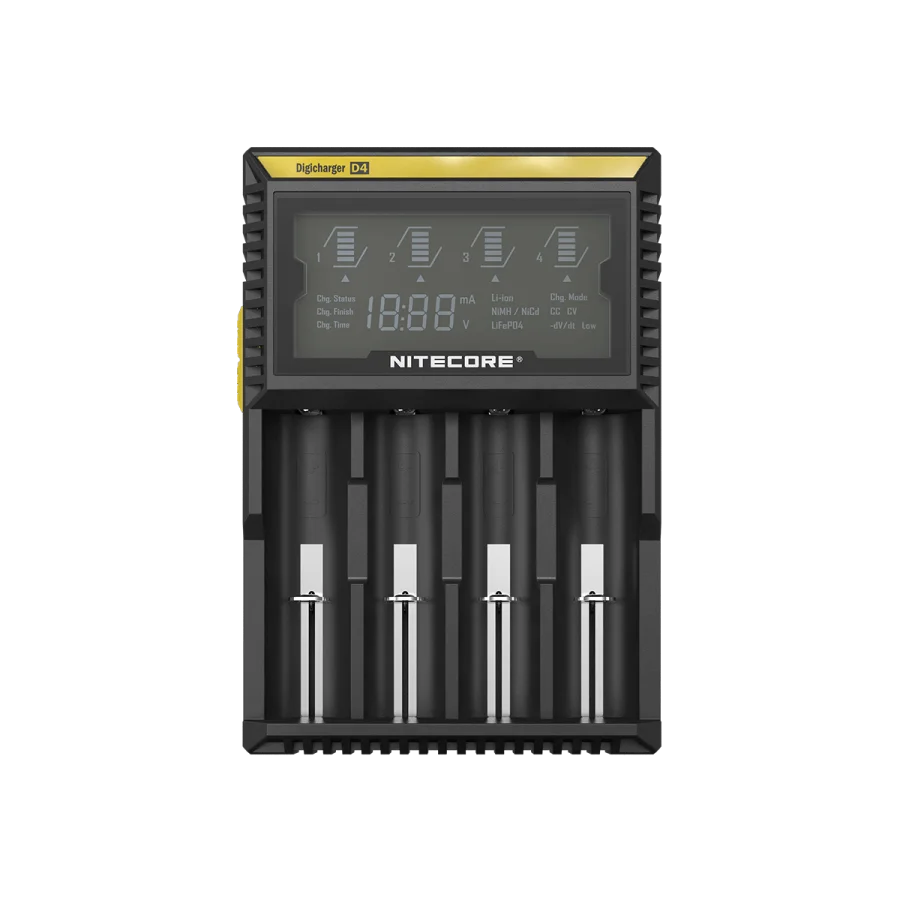
Image: Nitecore.
Key specs: Slots: four independent channels; Input: 100-240V AC or 12V DC; Output per slot: 375mA with four in use or 750mA with two; NiMH/NiCd sizes: AA, AAA, AAAA and C.
The $36.85 D4 is a corded desktop alternative for someone with household NiMH cells and compatible flashlight batteries. Its display shows voltage, current and charging progress. Nitecore’s supported-cell list matters more than the word “universal”: D-size NiMH is not listed, and supported LiFePO4 cells need the correct manual selection described in the D4 manual.
This is a multi-chemistry charger, not a capacity analyzer. The extra display information doesn’t create a discharge test. Skip D4 if you only charge eneloop AA/AAA batteries; CC55 is cheaper and simpler. The D4’s case is sharing one mains-powered charger across a verified compatible collection, not being automatically better because it handles more battery types.
One Household, Three Different Reasons to Upgrade
Suppose two game controllers each use two AAs and a toy uses four. That’s eight cells to replenish. TN480U can hold that whole batch; a four-slot charger needs two loads. This is a slot-count example, not a claim that Tenergy finishes the job twice as fast. Current, battery capacity and starting charge still determine time.
Now suppose only one controller needs a pair. Extra bays don’t solve the urgent problem; CC55’s published two-cell charging time becomes the useful distinction. Keeping an already charged spare pair may matter more than upgrading again.
Finally, suppose one pair dies much sooner than the others even though both cells show full. A status light answers “has charging finished?” A capacity test addresses a different question: “how much can this cell deliver under the test conditions?” VC4SL is the relevant option here. A refresh cycle doesn’t guarantee restored capacity. Don’t repeatedly force a damaged or rejected battery through charging.
Who Should Buy What
- Starting an eneloop AA/AAA setup: CC55, plus the appropriate cells for your device.
- Charging ahead with no hurry: CC17, particularly if its delivered cost remains lower.
- Several toys, controllers or devices at once: TN480U, after checking the USB supply.
- Comparing aging rechargeable cells: VC4SL, for its actual test mode.
- A mixed supported NiMH/lithium collection: D4, if AC power and its compatibility list suit the collection.
For field audio, choose the recorder first and then follow its battery specification; our portable recorder guide covers a different part of that kit. These chargers also aren’t substitutes for a home-office UPS or a car battery maintainer. Battery size, voltage and intended use define entirely different products.
FAQ
Can I mix AA and AAA batteries in one charge?
These models provide independent slots for supported cells, and their documentation permits the relevant AA/AAA combinations. That doesn’t authorize mixing arbitrary chemistries. Check the charger and battery instructions, polarity and condition before loading. For Panasonic, the recommendation here is eneloop and eneloop Pro cells.
Does a full indicator mean the battery is still healthy?
No. It means the charger reached its completion condition, not that the battery retains its original usable capacity. CC55’s colors are a rough charge estimate. A supported capacity-test mode, such as VC4SL’s, answers a different question, and its result still depends on test conditions.
Can these charge rechargeable 1.5V lithium AA batteries?
Don’t assume so. This comparison centers on 1.2V NiMH AA/AAA cells. Even the XTAR and Nitecore models that support certain higher-voltage lithium-ion cells are not automatically compatible with regulated 1.5V rechargeable AA batteries. Use the charging system specified for the exact cell.
Should I leave batteries charging overnight?
Automatic termination is not permission to ignore the operating instructions. Use the specified power supply and a suitable dry, ventilated location, monitor charging, and remove completed cells as directed. Panasonic instructs users to remove cells and unplug after completion. Never try to recharge leaking, damaged or disposable batteries, and use safety-device batteries only as their manufacturer specifies.
Bottom Line
For everyday eneloop swaps, Panasonic CC55 offers the clearest improvement for very little extra money. Buy more slots when you’re queuing batteries, and buy a capacity-test function when you’re investigating weak ones. Neither a larger screen nor a longer chemistry list is an upgrade unless it solves the problem you actually have.
This article contains affiliate links. PicksLab may earn a small commission at no extra cost to you. Our recommendations are based on the review method described in this article.