Affiliate disclosure: PicksLab earns commissions on qualifying Amazon purchases via the pickslab-20 tag, at no extra cost to you.
Want to record a conversation, a band rehearsal or the sound of a place without bringing a laptop? A portable recorder can sit near the sound while your phone stays in your pocket. It gives you physical recording controls, a headphone connection and files you can take into an editor afterward. The important question is whether its built-in microphones are enough, or whether you need a separate microphone for each person.
That decision separates this shortlist more clearly than price. The Zoom H1essential is the inexpensive self-contained option. The H4essential costs more because it can record two external XLR microphones alongside its built-in stereo pair. Tascam adds adjustable microphone angles, Roland adds remote operation and safety recording, and OM System combines internal storage with remote control and Bluetooth monitoring.
TL;DR - Our top pick: Zoom H4essential is the most flexible option here for someone who needs both built-in microphones and two external inputs. For straightforward stereo recording without XLR microphones, the H1essential costs half as much at this check.
Prices and What Each Recorder Adds
New-item US offers checked October 18, 2026, sorted by price. Taxes and destination-dependent shipping are excluded. Prices do not include optional microphones, windscreens, headphones or a memory card unless the selected package expressly includes one. These are displayed purchase prices, not coupon or card savings.
| Product | Price checked | What you are buying | Main reason to consider it |
|---|---|---|---|
| Zoom H1essential | $109.99 | H1e Only | Low-cost stereo recording with 32-bit float WAV |
| Tascam DR-07X | $149.00 | DR-07X recorder | Physically adjustable A-B/X-Y stereo microphones |
| Zoom H4essential | $219.99 | H4essential Only | Two XLR/TRS inputs plus built-in stereo microphones |
| Roland R-07 | $247.99 | Black R-07 | Remote control and a lower-level safety recording |
| OM System LS-P5 | $249.99 | Standalone LS-P5 | 16GB internal storage, directional control and Bluetooth monitoring |
The Tascam offer was sold and shipped by Certified Brands; the other four were sold and shipped by Amazon.com. The DR-07X is the older 24-bit model, not the newer DR-07XP. Those names are easy to confuse, but their recording formats differ.
Microphones, Inputs and File Workflow
| Product | Built-in microphones | External input | Recording format | Connection/workflow |
|---|---|---|---|---|
| H1essential | Fixed X/Y stereo pair | 3.5mm mic/line; no XLR | 32-bit float WAV, up to 96kHz | USB-C file transfer and USB microphone mode |
| DR-07X | Adjustable A-B or X-Y pair | 3.5mm stereo mic/line; no XLR | Up to 24-bit/96kHz WAV; MP3 | Micro-USB; two-in/two-out interface mode |
| H4essential | Fixed X/Y stereo pair | Two XLR/TRS combo inputs; 3.5mm mic/line | 32-bit float WAV, up to 96kHz | USB-C; four-in/two-out interface mode |
| R-07 | Stereo pair | 3.5mm stereo mic/aux; no XLR | Up to 24-bit/96kHz WAV; MP3 | Micro-USB; Bluetooth remote and playback |
| LS-P5 | Three-microphone TRESMIC II system | 3.5mm mic/line; no XLR | Up to 24-bit/96kHz WAV/FLAC; MP3 | Micro-USB; Bluetooth remote and headphone monitoring |
The maximum file resolution does not necessarily apply to every USB, safety-recording or wireless mode. Roland’s dual-WAV mode is limited to 44.1/48kHz, and the H4essential uses 44.1/48kHz when recording to its card while also acting as a USB interface.
Buy for the Number of Sources, Not the Number of Files
For a rehearsal or ambient recording, a built-in stereo pair captures the scene around the recorder. All five options can do that without a separate microphone. A phone may already be enough for a casual voice memo; the reason to buy a recorder is the particular control, placement, input or file workflow you need, not an assumption that any dedicated device will transform distant sound.
For an interview with two people, one recorder on the table captures both voices and the room together. If you want to adjust each voice independently afterward, use two microphones on separate inputs. The H4essential is the only model in this list with two XLR/TRS inputs for that job. Its onboard stereo pair can capture room sound at the same time. Microphones and cables are additional purchases; our XLR microphone guide explains the other half of that setup.
Two files are not always two independently placed sources. Roland’s dual recording saves the same input at different levels, providing a quieter backup. It does not turn the R-07 into a four-input interview recorder. Likewise, the three microphones in the LS-P5 shape its stereo pickup; they are not three independent XLR channels.
| Your recording job | Minimum useful setup | What to budget beyond the recorder |
|---|---|---|
| One conversation or rehearsal in a room | Built-in microphones, positioned near the source | Compatible storage, batteries and headphones |
| Outdoor ambience | Built-in stereo microphones | A fitted windscreen and a support that avoids handling noise |
| Two people with separate microphones | H4essential and two suitable XLR microphones | Two cables, stands/clips, headphones and storage |
| Four people each needing an isolated microphone | A recorder or mixer with at least four suitable inputs | None of these five alone meets that requirement |
For a tabletop podcast with more microphones, phone guests or sound pads, see our podcast mixer comparison. That is a different purchase from a small field recorder.
1. Zoom H1essential
Buy Zoom H1essential on Amazon ->
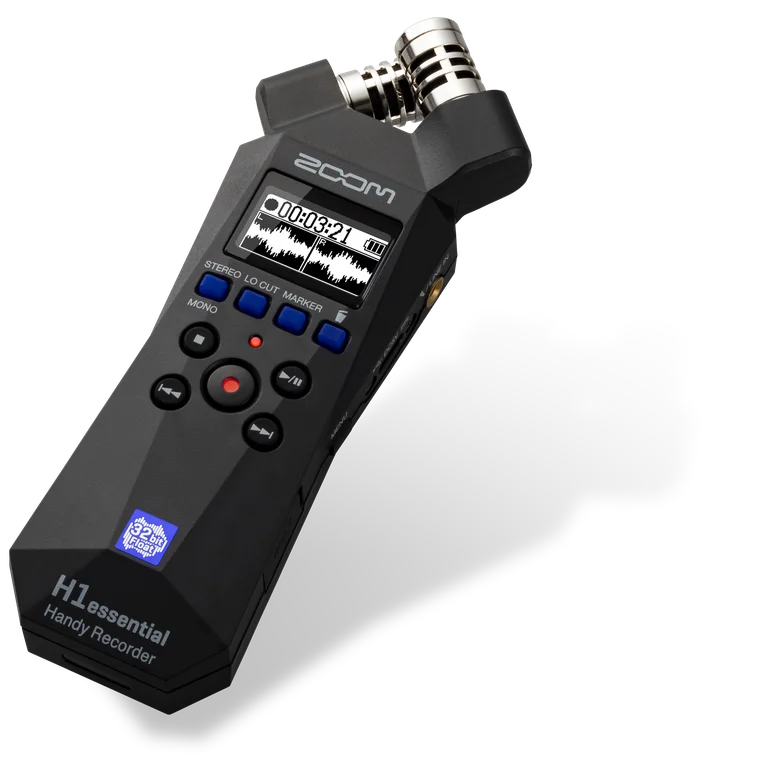 Image: Zoom.
Key specs: Built-in microphones: X/Y stereo; WAV format: 32-bit float up to 96kHz; External input: 3.5mm mic/line; USB connector: USB-C; Battery supply: two AAA cells.
The H1essential is the economical choice when its own stereo microphones cover the job. The recorder-only option was $109.99. It lets you capture a rehearsal, interview or location sound to a memory card and later adjust the file level in compatible editing software. Its physical controls also let you mark moments during a recording instead of trying to remember the timestamp afterward.
There is a 3.5mm input for a compatible external microphone, but no XLR socket or 48V phantom-power supply. Skip it if you need two separate XLR microphones. A passive plug adapter does not give it the H4essential’s inputs or power capabilities.
The H1essential manual covers file transfer and USB microphone mode. Use a data-capable USB-C cable and select the appropriate mode; merely connecting a cable does not choose your recording application’s input. Standalone recording uses the recorder’s controls without a phone app. Zoom’s official support and firmware page is the place to check operating-system compatibility and updates.
2. Tascam DR-07X
Buy Tascam DR-07X on Amazon ->
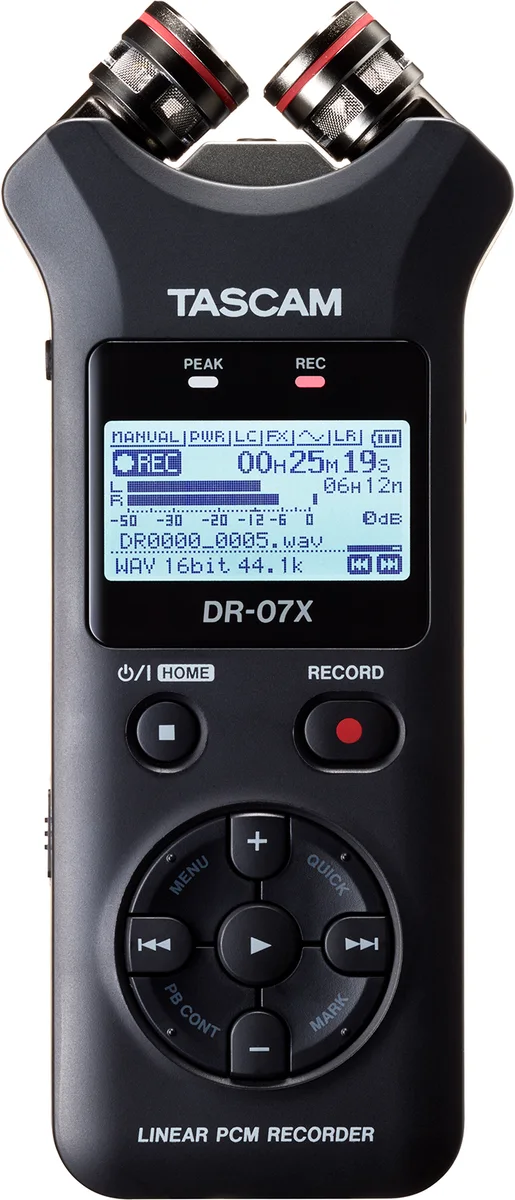 Image: Tascam.
Key specs: Microphone positions: A-B or X-Y; WAV resolution: up to 24-bit/96kHz; Storage: microSDXC up to 128GB; USB interface: two inputs/two outputs; Power: two AA batteries or USB.
Tascam earns its place for the microphones you can physically reposition. The $149.00 DR-07X can use an A-B arrangement for a wider stereo scene or an X-Y arrangement for a more focused stereo image. That gives someone recording acoustic music or room ambience a concrete adjustment to experiment with, rather than another digital effect to apply later.
This is a conventional 24-bit recorder: set and monitor the input level. It does not have the DR-07XP’s 32-bit float recording, and its older Micro-USB connection may mean carrying another cable. Skip the DR-07X if 32-bit float capture is a requirement. The H1essential is cheaper at this check, so the Tascam needs to earn the extra cost through its adjustable microphone arrangement or other workflow features you will actually use.
The official DR-07X specifications and downloads include firmware, manuals and the Windows ASIO driver. USB interface mode supports Mac, PC and compatible iOS setups; verify the current OS compatibility notes and required adapter before relying on a phone connection. A charge-only Micro-USB cable cannot transfer recordings.
3. Zoom H4essential
Buy Zoom H4essential on Amazon ->
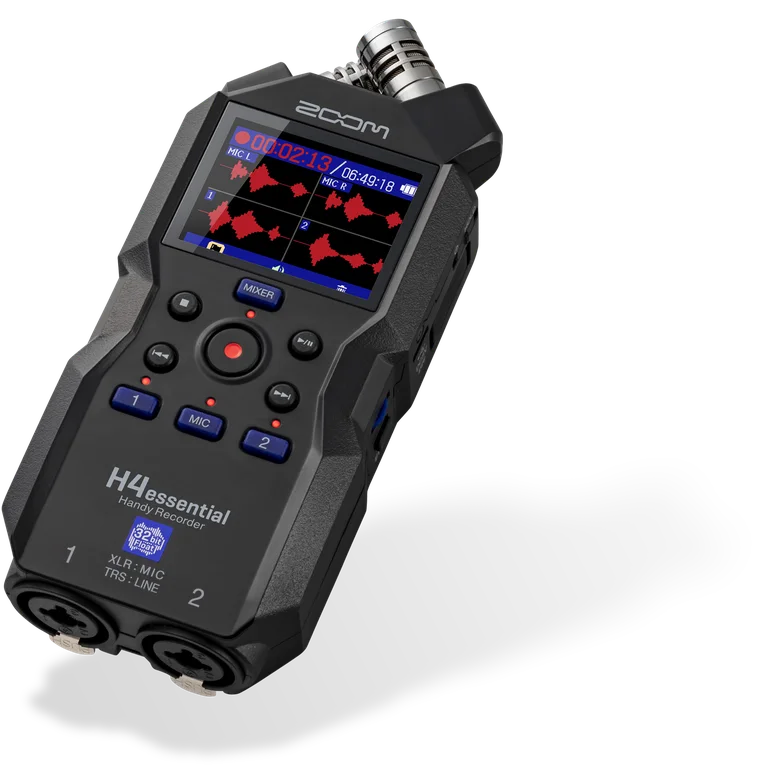 Image: Zoom.
Key specs: External inputs: two XLR/TRS combo jacks; Phantom power: 48V; Source tracks: four with the built-in stereo pair; WAV format: 32-bit float; USB interface: four inputs/two outputs.
The H4essential is the practical step up for two external microphones and room sound in one take. At $219.99, you are buying connections and independent tracks that the smaller recorders do not provide. For a two-person interview, each microphone can go to its own input while the onboard pair records ambience. Later, you can adjust the voices separately instead of turning the entire room up whenever the quieter person speaks.
It is still a two-XLR-input recorder, not a four-microphone podcast console. Skip it if you need four separate XLR microphones at once. Conversely, if you never expect to connect external microphones, the H1essential leaves more money for a windscreen and headphones.
The H4essential manual distinguishes USB-interface-only operation from simultaneous card recording: the latter uses 44.1 or 48kHz. Windows 32-bit float interface operation requires Zoom’s driver and compatible recording software. Use the official H4essential downloads, not a third-party driver site. The controls work standalone; optional wireless control requires additional hardware, not merely a Bluetooth-capable phone.
4. Roland R-07
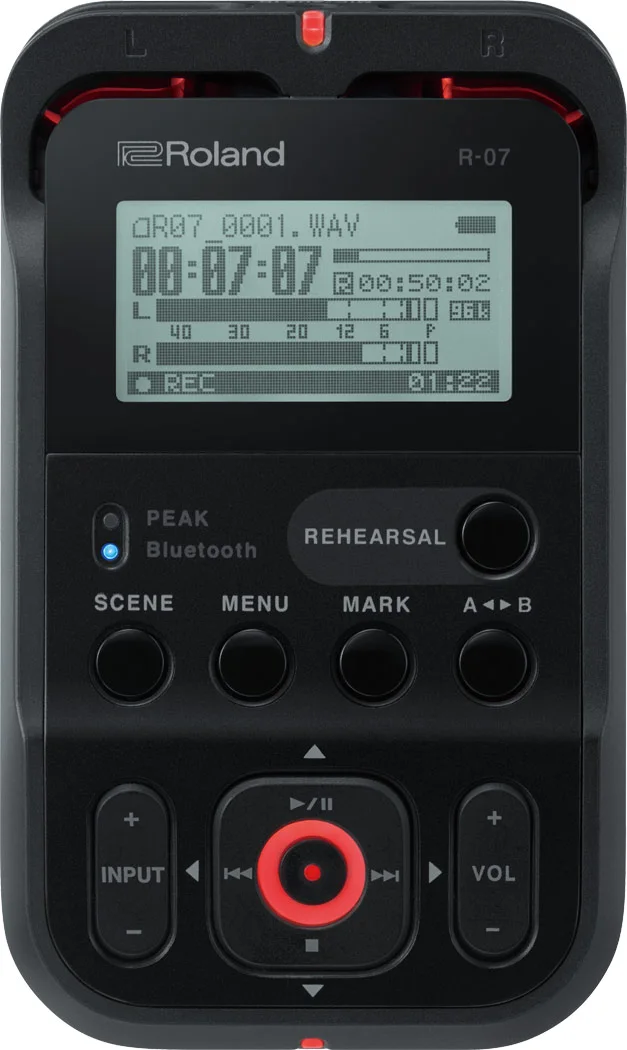 Image: Roland.
Key specs: WAV recording: up to 24-bit/96kHz; Safety recording: dual WAV at 44.1/48kHz; Power: two AA batteries; USB connector: Micro-B; External input: 3.5mm stereo mic/aux.
The R-07 suits a recorder left in place while you operate it remotely. The black version was $247.99. Roland’s scene presets let you prepare settings for different recording situations, while dual recording makes a second, lower-level capture of the same input. That backup can be useful when the main recording level is too high, although it does not repair an overloaded microphone.
Its wireless functions need a careful distinction. Roland’s specifications describe Bluetooth headphone playback, with restrictions including no 88.2/96kHz playback over that connection. Do not buy it expecting wireless live monitoring just because the listing mentions Bluetooth. Skip it if Bluetooth monitoring during the take is your deciding feature.
Use R-07 Remote and the official downloads for supported iOS/Android remote-control setups, and check the current app-store device requirements before purchase. USB audio functionality requires system software version 1.100 or later and operates at 44.1/48kHz. Remote control, Bluetooth playback and USB audio are separate features, not interchangeable ways to stream every recording mode.
5. OM System LS-P5
Buy OM System LS-P5 on Amazon ->
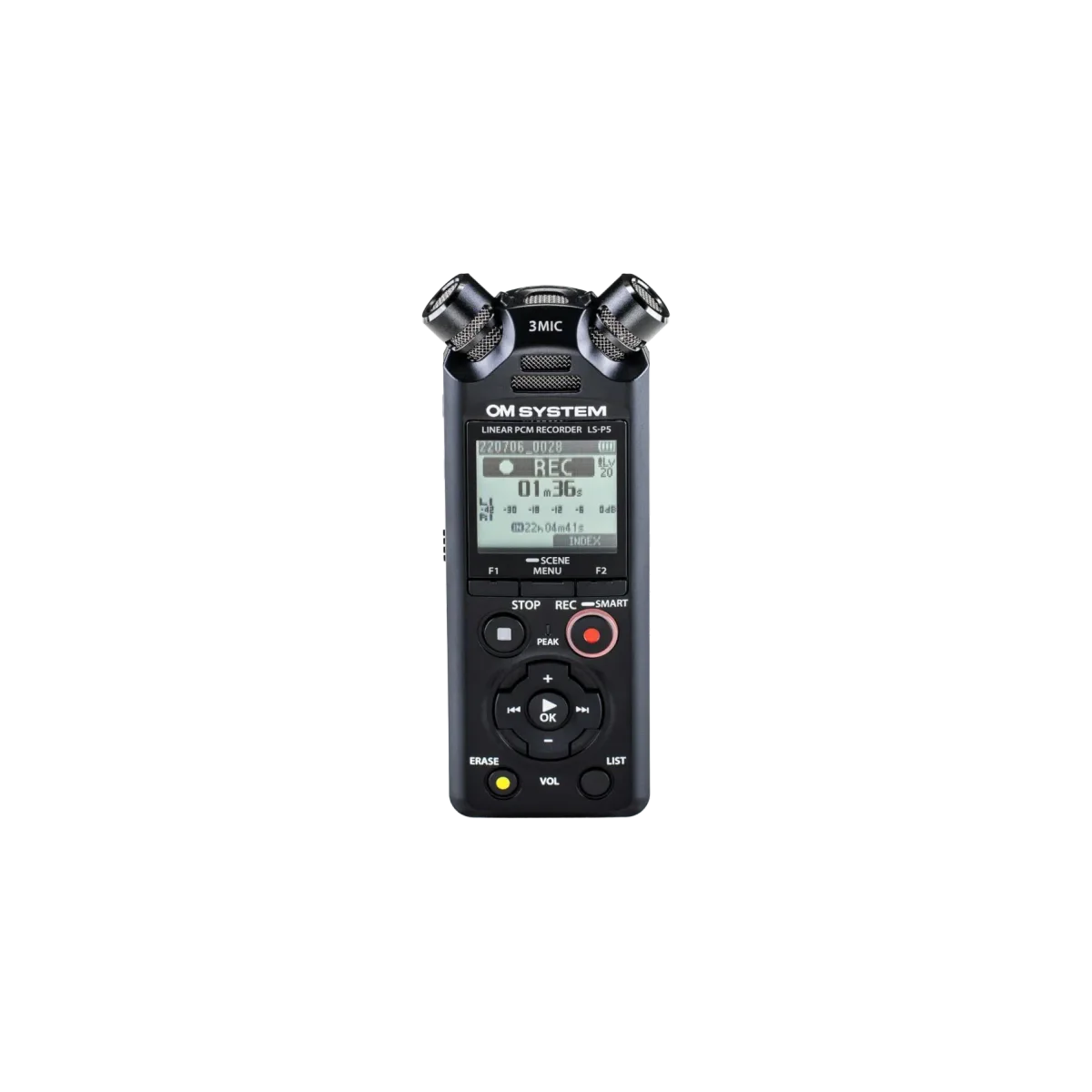 Image: OM System.
Key specs: Internal storage: 16GB; Microphone system: TRESMIC II with 21 zoom levels; WAV/FLAC resolution: up to 24-bit/96kHz; Battery supply: two AAA cells; External input: 3.5mm mic/line.
The LS-P5 is the compact option for internal storage and remote-controlled recording. The standalone unit was $249.99. Its three-microphone system lets you adjust directionality, moving between a wider scene and a narrower pickup. That changes what you emphasize; it does not make a distant conversation sound as though the microphone were next to the speaker.
Unlike a recorder that needs a card before its first take, the LS-P5 has 16GB built in, plus removable-card support. OM System also documents Bluetooth headphone monitoring. That is a meaningful difference from the R-07’s playback-only wireless headphone mode, although wireless monitoring still needs a compatible headset and should be checked with your setup before an important session.
The official OM System software page links DVR.Remote for Android and Apple devices and the firmware updater. DVR.Remote needs Bluetooth pairing with the LS-P5; it is not a web app or a remote internet connection. Skip the LS-P5 if you need XLR inputs or 32-bit float recording. Its price buys compactness, storage and wireless functions rather than those capabilities.
What 32-Bit Float Does Not Fix
32-bit float WAV gives you more freedom to change the level after recording. It does not eliminate the physical limits of the microphone and analog input. Zoom’s H4essential troubleshooting instructions explicitly describe input-overload warnings and advise increasing the distance from an excessively loud source. Wind can also overload a microphone.
That is why placement and monitoring still matter. A recording can have a recoverable file level and still contain wind, handling noise, room echo or distortion captured before conversion. Use a suitable windscreen outdoors, keep fingers away from the microphones and listen through headphones before committing to a long take. Our closed-back headphone guide covers options for listening without feeding as much sound back into the microphones.
Before leaving home, record a short test, transfer it and open it in your actual editor. Confirm that your software handles the selected format, that your data cable works and that the card is supported. Keep a second copy before erasing anything from the recorder.
For recorders whose manuals permit rechargeable NiMH AA or AAA cells, our AA/AAA charger comparison explains quick top-ups, charging a larger batch of spares and checking aging cells. Confirm the recorder’s supported chemistry and battery-type setting first; a battery fitting the compartment isn’t enough.
Who Should Buy What
- Simple stereo recording at the lowest price here: Zoom H1essential.
- Adjustable stereo microphone placement for music: Tascam DR-07X, accepting its 24-bit format and older USB connector.
- Two external interview microphones plus ambience: Zoom H4essential.
- Remote operation with a lower-level safety capture: Roland R-07.
- Internal storage and Bluetooth headphone monitoring: OM System LS-P5.
FAQ
Do I need a recorder if my phone can record audio?
Not necessarily. Try the phone first for casual notes or a simple recording where you can place it close enough. A dedicated recorder becomes useful when you need physical controls, separate storage, an external-input arrangement, standalone operation or a particular monitoring workflow. Buy for one of those needs rather than the label alone.
Can I plug a USB microphone into one of these recorders?
Do not assume that you can. Their USB audio modes connect the recorder to a computer or compatible mobile host; a USB socket does not automatically make the recorder a host for a separate USB microphone. For the H4essential’s external microphone inputs, use suitable analog XLR/TRS equipment and follow its input and power requirements.
Does 32-bit float mean the audio cannot distort?
No. It provides file-level headroom, but the microphone or analog input can still overload, and wind or handling noise is still recorded. Move away from an excessively loud source, monitor the take and use appropriate wind protection. Lowering the file level later cannot reconstruct sound already distorted before conversion.
Which one should I buy for a two-person interview?
For one recorder on a table capturing both people, any of the built-in microphone options may suit the setup. If each person needs an isolated microphone track, the H4essential is the relevant choice here because it has two XLR/TRS inputs. Budget for microphones, cables and stands as well; the recorder-only offer does not include that complete interview kit.
Bottom Line
The H1essential is a reasonable starting point for someone recording with the built-in microphones. The H4essential is the stronger buy when two external inputs are part of the plan. Spend more on Roland or OM System only when their remote, storage or monitoring features solve a real problem in how you record.
This article contains affiliate links. PicksLab may earn a small commission at no extra cost to you. Our recommendations are based on the review method described in this article.